

// PUBLIC SITE / 0.5
Tiny Tool Development
A governed Unreal tool ecosystem, from focused editor utilities to evidence-aware automation.
Fab shows the price. These pages show the editor surface you actually get.
UMCP is live on Fab; the next advanced tools are visible before their listings.
Small scope, visible workflow, restore button where it matters.
For teams tired of solving the same Unreal paper cut every sprint.
Documentation ships with the plugin — not as a post-release archaeology project.
Live product slides


product areas
AREAtools
TOOLSbridges
BRIDGEScatalogue range
UE// CURRENT FACTS
Published state, UE support, and product boundaries from the current catalogue.
Current catalogue facts keep source state, workflow boundary, function/settings/failure-mode coverage, and the UE 5.4-5.8 catalogue engine range visible.
Individual cards and pages show their declared or verified support separately.
Product-facts sheets currently feeding public catalogue copy.
Current code and test proof separated from later roadmap claims.
Products shown as publication queue, not live Fab listings.
Current companion adapters; IIS MCP exposure now routes through UCM and UMCP.
// PRODUCT AREAS
Small tools, clear ownership, real editor surfaces.
AI Plugins
Local indexes, provider routes, model policy, and agent-facing workflows.
Editor Tools
Editor governance, diagnostics, performance, asset quality, and rendering-review workflows.
Scene Tools
Spline, track, and environment tools for productive scene authoring.
Foundation Plugins
Setup-driven interoperability, capability registration, and route orchestration for plugin ecosystems.
Engine Plugins
Runtime and editor foundations for asset data, providers, and engine-level workflows.
Example Projects
Free companion integrations and reference adapters that keep ownership boundaries visible.
Outer Tools
Standalone tools around the Unreal plugin ecosystem, including modeling and architecture workflows.
// INDEX
Product catalogue for Unreal workflows.
AI Plugins
Available on Fab
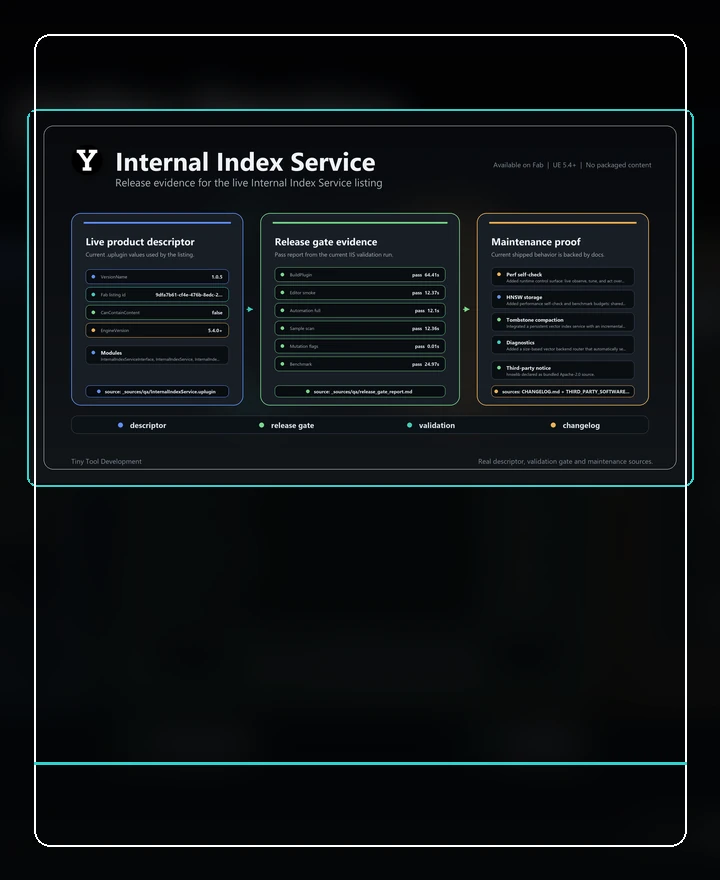
Internal Index Service
Agents guess from whatever file was open — not from project evidence.
UE5.4StateInternalIndexService.uplugin VersionName 1.0.8 / Version 6Surface6 functions / 15 settings / 5 failure modes / 2 bridges
Local indexes, retrieval, context packs, embedding jobs, and agent-facing search.
More context
Internal Index Service is available on Fab as a paid Unreal Engine plugin. It gives AI-assisted tools a local project memory layer with retrieval-only guardrails, context packs, embedding jobs, and inspectable agent-facing search.
- Boundary
- Local evidence indexing and retrieval service for Unreal projects; IIS imports prepared chunks, builds lexical/vector catalogs, assembles context packs, and exposes read-only search tools without mutating project assets.
- Workflow
- Import prepared evidence chunks, build the local catalog, search or assemble context packs, and optionally expose the same read-only retrieval tools to agents through Capability Mesh and Unified MCP Server.
- Functions
- ImportPreparedChunks; Search; BuildContextPack
- Settings
- Vector Backend; Index Root; Brute Force Max Records
- Failure modes
- Vector search returns no results.; HNSW index cannot load or produces backend warnings.; Runtime tune or index act-verb returns disabled.
AI Plugins
Available on Fab
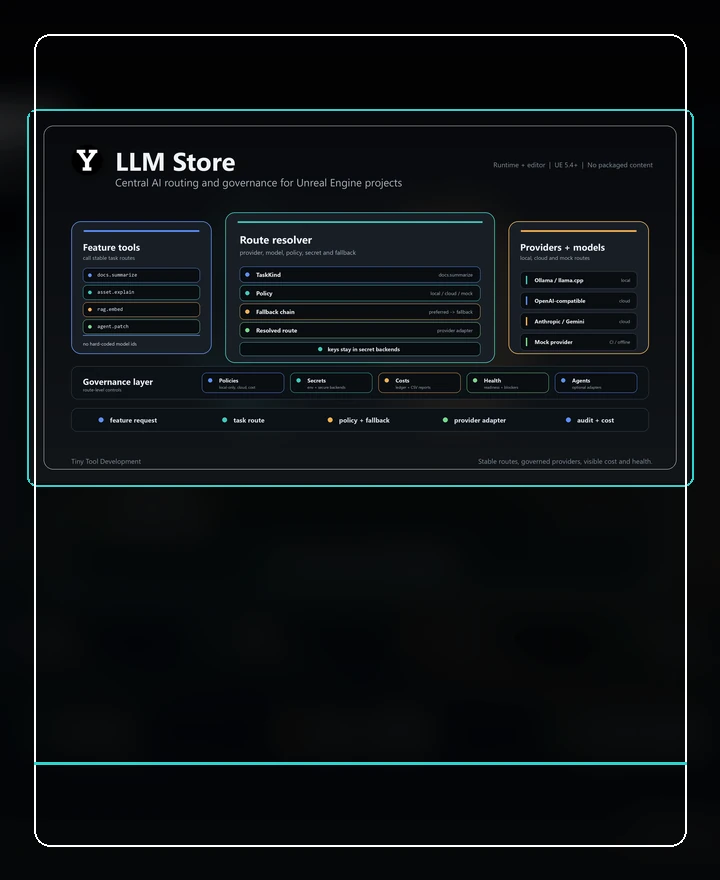
LLM Store
Every feature hardcodes its own model — and nobody sees the bill.
UE5.4StateLLMStore.uplugin VersionName 1.1.1 / Version 111Surface3 functions / 3 settings / 3 failure modes / 2 bridges
Central management for AI providers, models, routes, policies, costs, and secrets.
More context
An editor control point for local and remote models, including governance and optional agent-facing surfaces.
- Boundary
- Central Unreal governance and execution layer for providers, models, routes, policies, costs, secrets, and optional agent adapters.
- Workflow
- Configure providers, models, task routes, route policies, and secret backends, then execute stable TaskKind routes from feature plugins or tools.
- Functions
- TaskKind; Execute Route; Get Readiness
- Settings
- Providers; Routes; SecretBackend
- Failure modes
- Provider Is Not Reachable; Route Does Not Resolve; Missing API Key
AI Plugins
Available on Fab
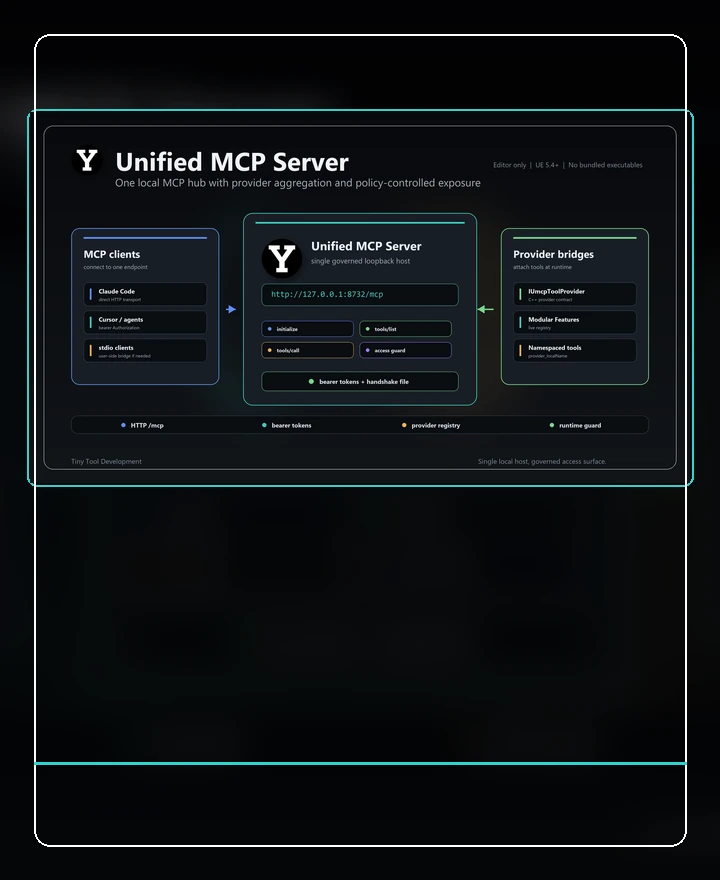
Unified MCP Server
Tool plugins each ship their own transport setup, and agent clients end up learning multiple patterns.
UE5.4StateUnifiedMcpServer.uplugin VersionName 1.0.10 / Version 9Surface4 functions / 3 settings / 4 failure modes / 1 bridge
Editor-only loopback MCP host with provider registry, bearer-token auth, and modular tool aggregation.
More context
Unified MCP Server (UMCP) is available on Fab. It hosts local MCP transport, discovers provider tools, and aggregates editor job status through UCM routes when Unreal Capability Mesh is enabled.
- Boundary
- Editor-local loopback MCP host with provider registry, scoped bearer tokens, access policy, and redacted diagnostics.
- Workflow
- Start the local MCP server, read the handshake file, configure a local client with a scoped bearer token, list tools, and call provider tools through the shared endpoint.
- Functions
- tools/list; tools/call; Rotate MCP Token
- Settings
- Server Port; Access Profile; Enable Access Journal
- Failure modes
- Status Response Would Expose Tokens; Client Gets 401 Unauthorized; Handshake File Is Missing

AI Plugins
Internal
Tiny Tool Execution Runtime
Tool discovery, execution state, progress, and cancellation fragment when every transport and plugin invents its own contract.
UE5.4-5.8StateDestination branches 5.5-5.8 pass Editor and Game gates with zero warnings; the UE 5.8 Epic bridge passes 6/6 automation tests.Surface1 function / 1 failure mode / 2 bridges
Owns tool, invocation, resource, and artifact lifecycle without owning transport or UCM policy.
More context
TTER keeps general execution behavior on the Unreal Engine 5.4 floor. Optional UMCP/UCM and UE 5.8 Epic adapters consume the product-owned registries through ITinyToolExecutionModule.
- Boundary
- One transport-neutral discovery and invocation contract for Tiny Tool providers from Unreal Engine 5.4 onward.
- Workflow
- Register a provider, discover descriptors, dispatch through the invocation registry, report progress, and return bounded typed content.
- Functions
- Discover and invoke Tiny Tools
- Failure modes
- Tool cannot be resolved
- Optional bridges
- TinyToolExecutionIntegrationBridge; UnifiedEpicMcpBridge

Example Projects
Free companion
Tiny Tool Execution Integration Bridge
UE5.4StateUE 5.4 build, live integration tests, UMCP tests, global autark gate, and isolated TTER package checks are green.Surface1 function / 1 setting / 2 failure modes / 1 bridge
Connects Tiny Tool Execution with Unified MCP Server and Unreal Capability Mesh.
More context
The bridge owns editor-only adapter registration and DTO translation. It reloads UCM setup before initial TTER discovery and normalizes natural projected-route arguments to the generic request_json endpoint convention while TTER, UMCP, and UCM retain lifecycle, transport, access, audit, and route authority.
- Boundary
- Optional editor adapter package that connects TTER registries to UMCP transport seams and UCM route projection without reversing core dependencies.
- Workflow
- Enable TTER, UCM, UMCP, and this bridge; at PostEngineInit the module reloads UCM setup, discovers projected routes, and registers meta-tools, resources, cancellation, and route adapters.
- Functions
- Register Tiny Tool Execution integration bridge
- Settings
- Bridge loading phase
- Failure modes
- Required integration plugin unavailable; Reflected projected route receives empty request values

AI Plugins
Advanced Preview
Project Restructure Service
Reviewed restructure ideas still become risky when the actual move/apply step is informal.
UE5.4StateProjectRestructureService.uplugin VersionName 1.0.1 / Version 2Surface3 functions / 3 settings / 3 failure modes / 1 bridge
Safe, gated project restructuring and placement execution for reviewed Unreal workflow plans.
More context
Project Restructure Service is an advanced-preview mutation authority for approved structural plans: validation, dry-run diffs, gate/hash checks, clean-git preflight, apply handlers, verification, run metadata, and rollback.
- Boundary
- Gated project restructuring executor for reviewed placement plans, deterministic dry-run diffs, hash-checked apply, verification, and rollback.
- Workflow
- Load a reviewed plan, validate trusted roots, build a dry-run diff, review hashes, apply with matching gate evidence, verify, and roll back by run id when needed.
- Functions
- BuildDryRunDiff; ApplyPlan; Rollback
- Settings
- TargetProjectRoot; SourceRoots; GateToken
- Failure modes
- Dirty Working Tree Blocks Apply; Gate Rejected; Verify Failed

AI Plugins
In Publishment
Unreal Integration Intelligence
Integration review produces useful knowledge, then loses shape before other tools can use it.
UE5.4StateDescriptor, package docs, UCM manifests, dossier core tests, Translation-Evidence input validation, and public projections reconciled; a full dual-index Translation-Evidence happy-path test and real Slot 01/02 product-image captures remain tracked follow-ups.Surface4 functions / 3 settings / 3 failure modes / 1 bridge
Unreal Integration Intelligence is in publishment for version 1.1.3 and prepares Unreal project evidence, System Dossiers, optional Translation Evidence, RAG-ready chunks, review packs, and bridge-ready handoff contracts.
More context
Unreal Integration Intelligence is an in-publishment evidence producer for Unreal projects: profile validation, project/source/asset evidence export, System Dossier generation, optional source/target Translation Evidence, review packs, RAG chunks, and IIS-ready handoff artifacts.
- Boundary
- Evidence producer for Unreal project truth, review packs, RAG-ready chunks, handoff contracts, and optional Translation Evidence without owning retrieval, embeddings, model routes, or mutation.
- Workflow
- Validate a profile, export local Unreal evidence, build review or handoff artifacts, and let downstream owners index or consume them after review.
- Functions
- Export Evidence; Validate Profile; Read Latest Handoff
- Settings
- ProfileId; AllowedSourceRoots; RootContentPath
- Failure modes
- Profile Invalid; Export Writes No Artifacts; Handoff Missing
Foundation Plugins
Available on Fab
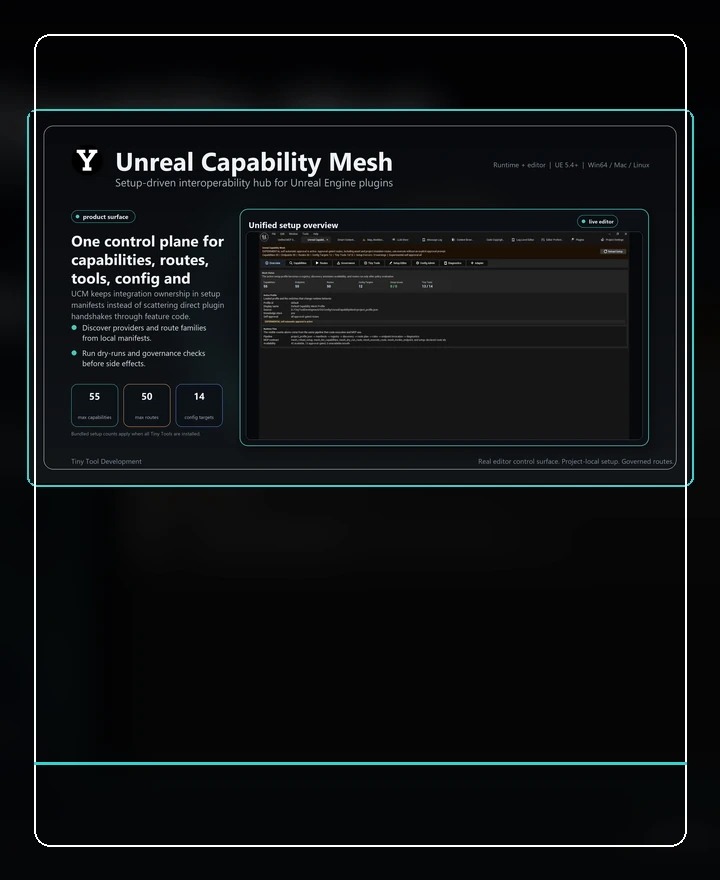
Unreal Capability Mesh
Every plugin integration has to choose between direct coupling and brittle glue code.
UE5.4StateCore setup, discovery, planning, execution, orientation, and editor surfaces verified; plugin-local manifests demonstrated in packaged foreign-editor hosts; TTER projection and runtime/editor separation implemented and UE 5.4 verified.Surface3 functions / 3 settings / 3 failure modes / 1 bridge
Setup-driven interoperability hub for Unreal plugins through manifests, capabilities, schemas, and route governance.
More context
Unreal Capability Mesh is published on Fab. It lets editor plugins discover capabilities, compose reviewable routes, expose editor job surfaces, and run declared tool chains without direct compile-time coupling. Plugin-local manifests can travel in packaged engine plugins, and the optional TTER integration projects those routes while UCM retains its implemented planning, effective approval and dry-run fields, and route-result authority. Transform mappings remain a separate callable surface and are not applied by route execution.
- Boundary
- Setup-driven interoperability hub for declared capabilities, endpoints, schemas, rules, routes, transforms, adapters, diagnostics, and generic gateway access.
- Workflow
- Reload setup, inspect discovered capabilities and routes, dry-run route plans, execute approved routes, and review local diagnostics and reports.
- Functions
- Reload Setup; Dry Run; Route Catalog
- Settings
- project_profile.json; experimental_self_approval_all_routes; enabled_route_manifests
- Failure modes
- Setup Load Fails; Route Is Blocked; Endpoint Invocation Fails
Scene Tools
Available on Fab
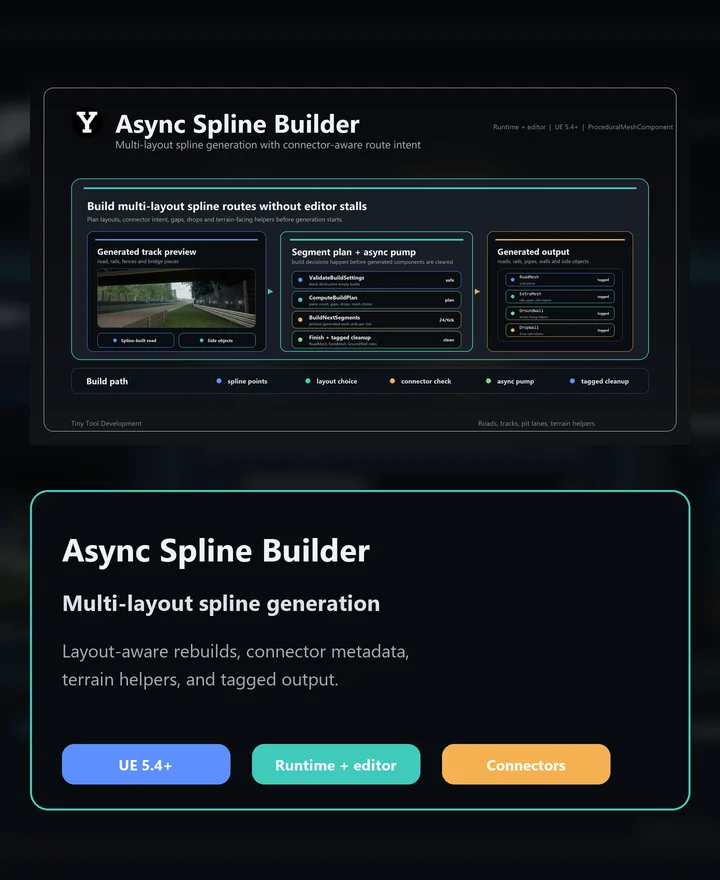
Async Spline Builder
One spline tweak can turn into layout, connector, terrain, and rebuild coordination.
UE5.4StateAsyncSplineBuilder.uplugin VersionName 1.1.3 / Version 3Surface7 functions / 4 capabilities / 5 settings / 5 failure modes / 1 bridge
Builds multi-layout roads, tracks, pipes, rails, walls, and side objects along Unreal splines.
More context
Useful for technical route, circuit, and environment authoring with repeatable segment workflows, native track-shape editing, tagged cleanup, connector-aware layout metadata, and visual-only connector endpoint labels.
- Boundary
- Scene-authoring spline generator for roads, tracks, pipes, rails, walls, side objects, layout-aware builds, native editor track-shape authoring, passive layout connector metadata, and optional connector endpoint diagnostics.
- Workflow
- Place or select an ASplineGeneratingActor, author main/pit/alternate layouts in the panel or native Track Shape Editor, validate settings and connectors, optionally inspect connector endpoints, rebuild tagged geometry, and optionally apply landscape or wall tools.
- Functions
- Track Shape Editor; Build Now; Rebuild
- Capabilities
- multi_layout_builds; native_track_shape_editor; layout_connectors
- Settings
- MainMesh; SegmentsPerTick; bGenerateGroundWalls
Editor Tools
Available on Fab
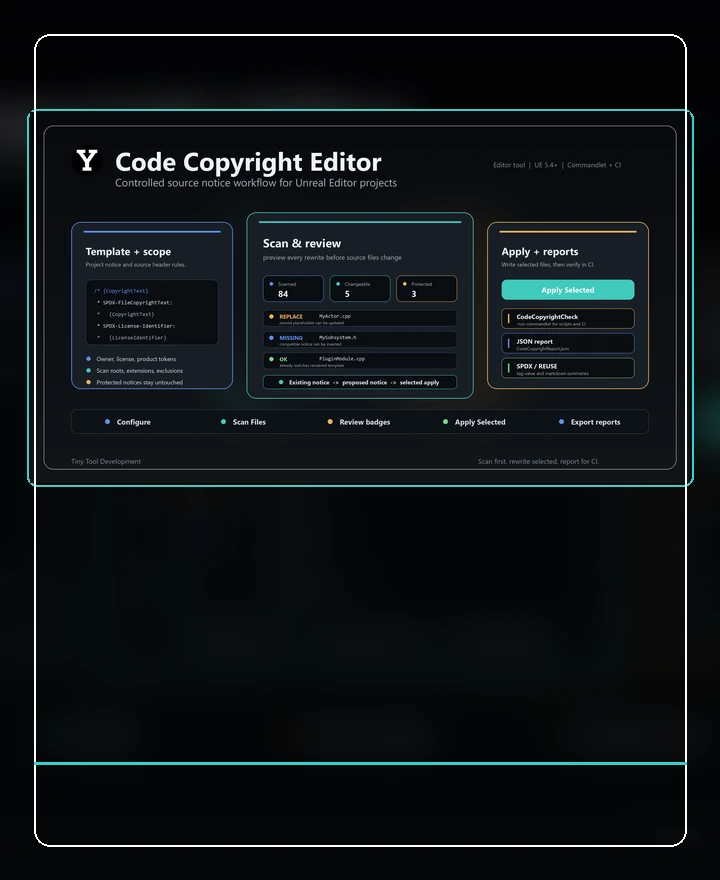
Code Copyright Editor
Release week finds headers that never matched the template.
UE5.4StateCodeCopyrightEditor.uplugin VersionName 1.0.3 / Version 3Surface3 functions / 3 settings / 3 failure modes / 1 bridge
Keeps copyright headers, project notices, metadata, and CI checks consistent.
More context
For teams that do not want to maintain source notices manually or miss them during releases.
- Boundary
- Scan-first Unreal editor, commandlet, and optional route surface for controlled source notice review, selected rewrites, project notice updates, and evidence reports.
- Workflow
- Configure owner, license, templates, and scan scope; scan without mutation; review classifications; apply selected safe changes; and write reports when needed.
- Functions
- Scan Files; Apply Selected; Write Reports
- Settings
- OwnerName; SourceNoticeTemplate; ScanRootPaths
- Failure modes
- The Tool Does Not Appear In The Tools Menu; Scan Finds No Files; Write Errors
Editor Tools
Available on Fab
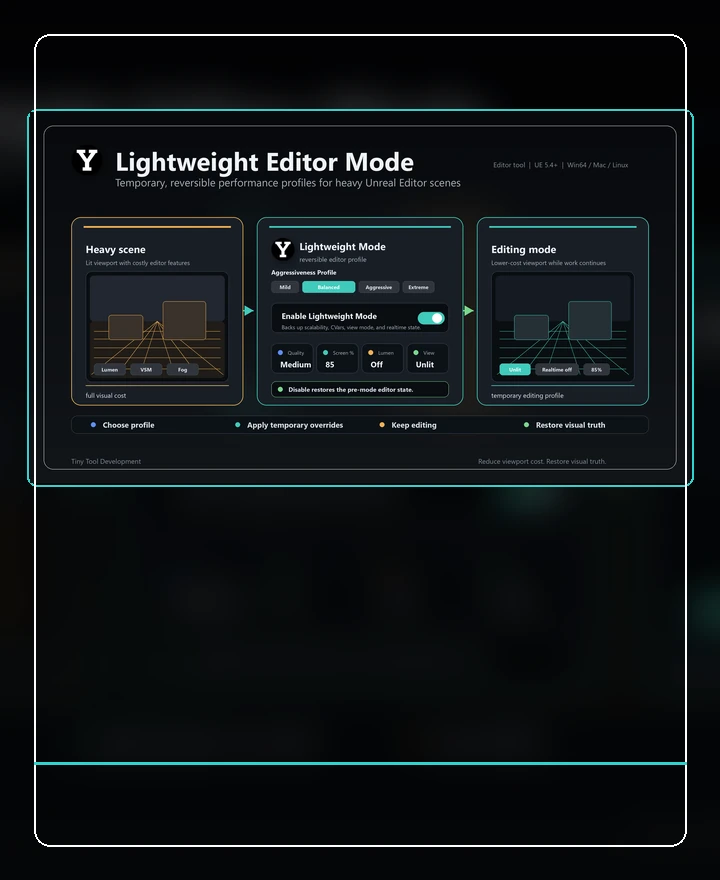
Lightweight Editor Mode
The viewport looks great until selecting an actor feels sluggish.
UE5.4StateLightweightEditorMode.uplugin VersionName 1.0.4 / Version 3Surface3 functions / 3 settings / 3 failure modes / 1 bridge
Reduces Unreal Editor viewport and rendering cost through reversible profiles.
More context
A tool for heavy projects, live demos, laptops, and any situation where editor responsiveness matters.
- Boundary
- Reversible editor performance overlay that applies visible profile-based viewport, scalability, CVar, and realtime reductions without changing runtime game settings.
- Workflow
- Choose a Mild, Balanced, Aggressive, or Extreme profile, enable lightweight mode while editing, and disable it to restore the previous editor state.
- Functions
- Enable Lightweight Mode; Disable Lightweight Mode; Refresh
- Settings
- AggressivenessLevel; ScreenPercentage; bForceUnlitViewports
- Failure modes
- The plugin window is missing; Viewports stay Unlit after disabling; Disable does not restore a CVar
Editor Tools
Available on Fab
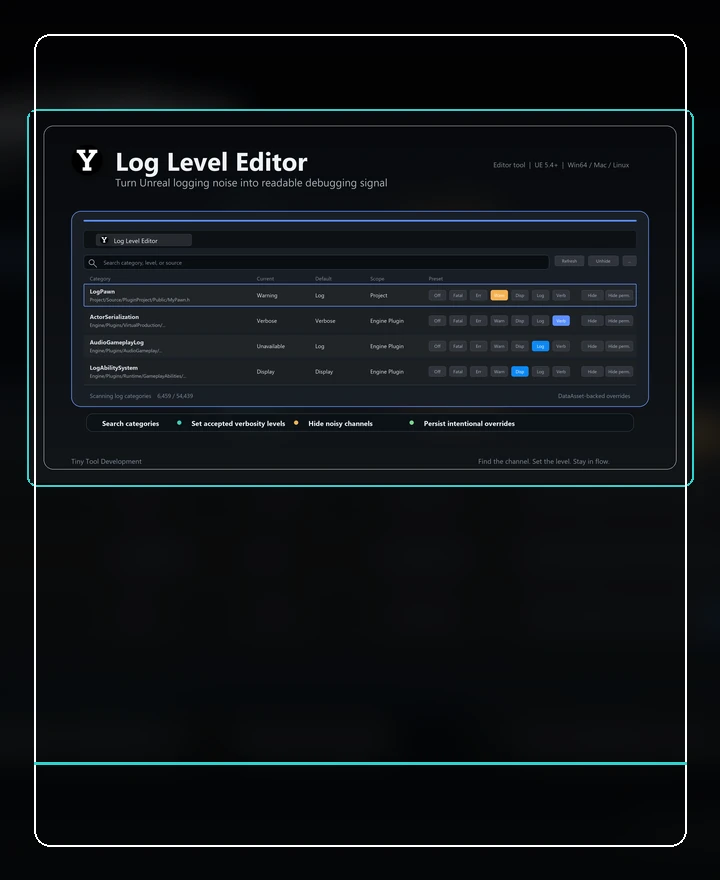
LogLevelEditor
The one log line you need is buried under fifty you do not.
UE5.4StateLogLevelEditor.uplugin VersionName 1.1.5 / Version 4Surface3 functions / 3 settings / 3 failure modes / 1 bridge
Finds Unreal log categories and changes verbosity levels in a focused surface.
More context
Helps debugging when logs need to become more precise without hunting through configuration files.
- Boundary
- Standalone editor surface for discovering Unreal log categories, inspecting verbosity, filtering noisy channels, and persisting intentional overrides.
- Workflow
- Scan source roots for log categories, review runtime/default verbosity, set intentional overrides, and persist selected changes in a DataAsset.
- Functions
- Scan; Set Verbosity; Hide Category
- Settings
- LogLevelDataAsset; bAlsoListEnginePluginChannels; LogChannelsToHide
- Failure modes
- The Tool Does Not Show My Category; Changing A Verbosity Does Nothing; Scanning Takes Too Long
Editor Tools
Available on Fab
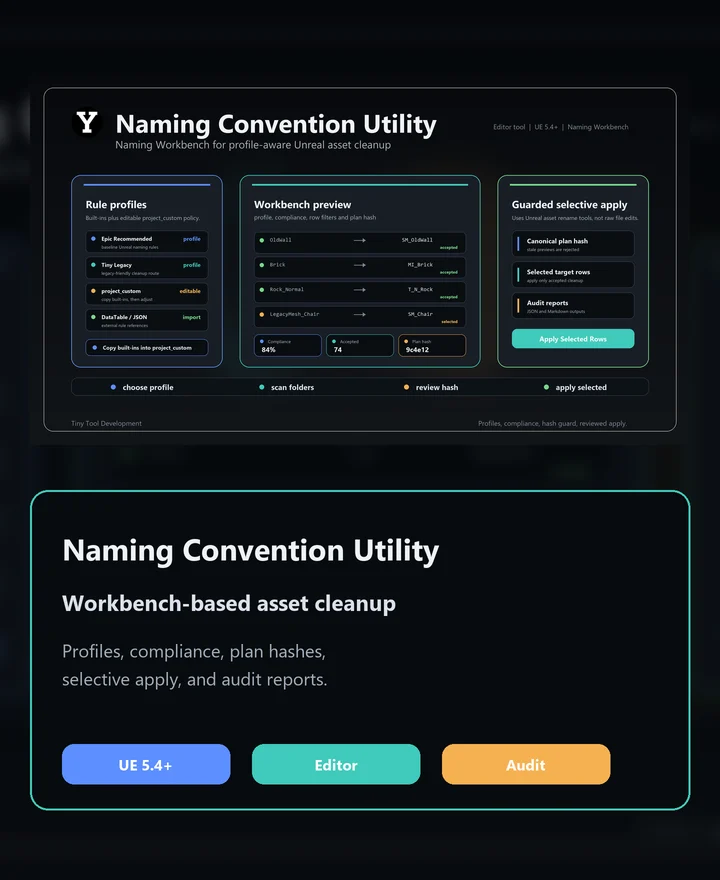
Naming Convention Utility
Everyone agrees on SM_ until a bulk rename touches real project references.
UE5.4StateNamingConventionUtility.uplugin VersionName 1.1.1 / Version 4Surface4 functions / 3 profiles / 4 capabilities / 3 settings / 3 failure modes / 1 bridge
Previews, scores, and applies Unreal asset naming rules through a guarded Naming Workbench.
More context
For projects where asset names are pipeline signals and folder cleanup needs reviewable policy, profile choice, selective apply, and audit evidence.
- Boundary
- Preview-first Unreal asset naming workbench with built-in profiles, compliance summaries, plan hashes, audit reports, and guarded AssetTools rename workflows.
- Workflow
- Define naming rules in a DataAsset or imported DataTable, open the Naming Workbench or Content Browser action, preview a rename plan, inspect compliance and skip reasons, and apply only accepted Unreal-safe renames.
- Functions
- Open Workbench; Preview; Apply
- Profiles
- Epic Recommended; Tiny Legacy 1.0.x; Project Custom
- Capabilities
- compliance_score; canonical_plan_hash; audit_report
Editor Tools
Available on Fab
Performance Preset Wizard
"Drop scalability for the demo" — and the project never quite returns.
UE5.4StatePerformancePresetWizard.uplugin VersionName 1.1.3 / Version 4Surface3 functions / 3 settings / 3 failure modes / 1 bridge
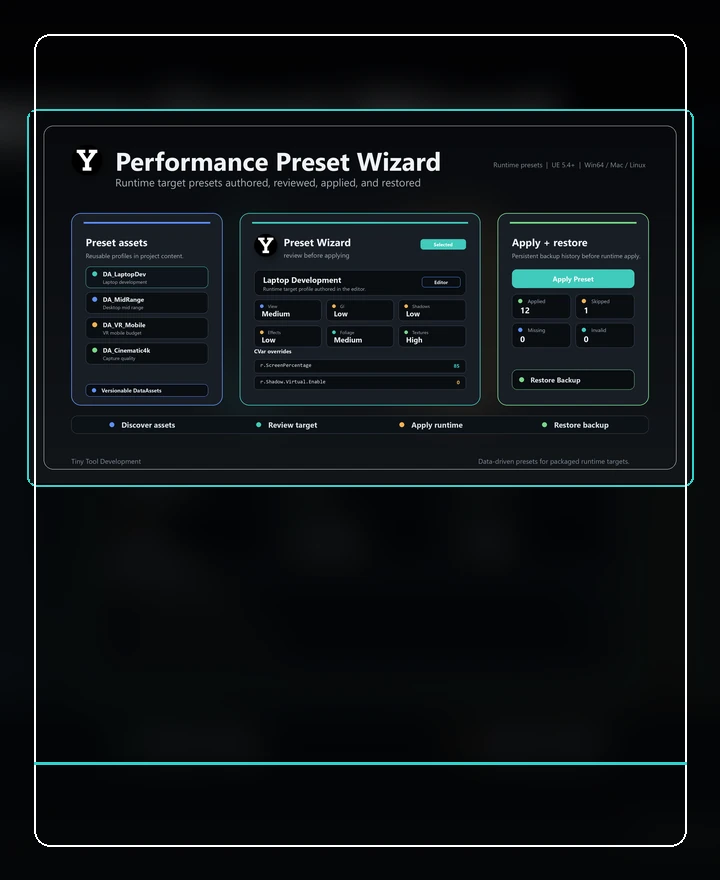
Creates, reviews, applies, and restores reusable performance presets.
More context
Turns scalability settings and CVar overrides into a traceable editor process.
- Boundary
- Runtime/editor preset authoring and apply/restore tool for reusable Unreal scalability and CVar profiles.
- Workflow
- Author or select a UPerformancePresetAsset, review its scalability and CVar effects, apply it manually, and restore the captured previous state when needed.
- Functions
- List Presets; Apply Preset; Restore Previous
- Settings
- Startup Preset; Runtime Preset Library; Max Backup History
- Failure modes
- No Presets Are Listed; A Preset Cannot Be Applied; Restore Previous Is Unavailable
Editor Tools
In Publishment
Smart Content Diet
The Content Browser grows; nobody knows what is safe to cut.
UE5.4StateSmartContentDiet.uplugin VersionName 1.0.6 / Version 5Surface3 functions / 3 settings / 3 failure modes / 1 bridge
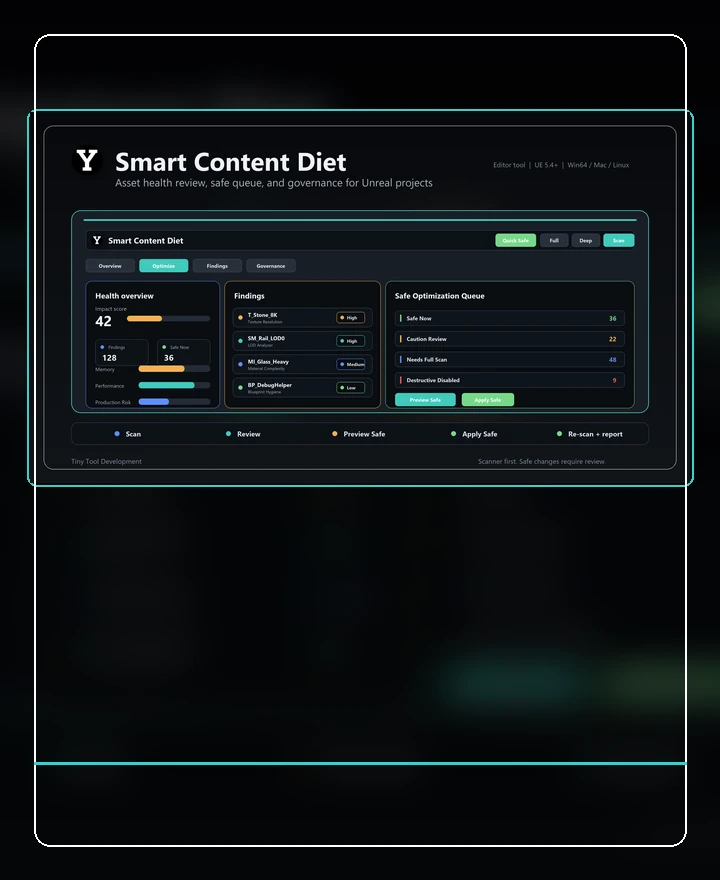
Content health review, analyzer coverage, cleanup queues, governance snapshots, and safe action previews.
More context
Smart Content Diet is in publishment. Its product surface is grounded in analyzer coverage, role-aware review text, UCM route notes, and preview/apply-safe cleanup boundaries.
- Boundary
- Safety-forward content-health analysis, review, preview, and guarded optimization workflow for Unreal assets.
- Workflow
- Open Smart Content Diet, run a Quick Safe scan, review findings, preview the safe queue, apply only reviewed safe fixes, and re-scan to measure improvement.
- Functions
- Quick Safe Scan; Preview Safe; Apply Safe
- Settings
- Role / Audience; Scan Depth; Approval / Safety
- Failure modes
- Run scan first; Apply is blocked or asks for approval; A cross-plugin route shows "available but plugin not loaded"

Example Projects
Free companion
SCD IIS Similarity Bridge
UE5.4StateMixed State - implemented free companion bridge outside active buyer-doc gate scopeSurface1 bridge
Connects SCD similarity requests and health evidence with IIS retrieval contracts.
More context
The bridge connects systems without blurring the ownership boundaries of Smart Content Diet and Internal Index Service.
- Boundary
- Free companion bridge that registers SCD provider id iis-similarity and imports SCD health-evidence JSONL into IIS prepared chunks without moving indexing ownership into SCD.
- Workflow
- Enable SCD, IIS, and the bridge, run SCD health scans, import evidence JSONL through the bridge, then request semantic similarity via the iis-similarity provider.
- Optional bridges
- UCM

Example Projects
Free companion
SCD PRS Bridge
UE5.4StateMixed State - implemented free companion bridge outside active buyer-doc gate scopeSurface1 bridge
Connects reviewed SCD placement moves with guarded PRS restructure workflows.
More context
The bridge connects systems without blurring the ownership boundaries of Smart Content Diet and Project Restructure Service.
- Boundary
- Free companion bridge that adapts reviewed SCD placement proposals into PRS validation, dry-run, apply, and rollback APIs without moving execution governance into SCD.
- Workflow
- Enable SCD, PRS, and the bridge, review SCD placement proposals, preview PRS validation and dry-run through the bridge, then apply only after explicit user confirmation.
- Optional bridges
- UCM

Example Projects
Free companion
SCD UII Migration Bridge
UE5.4StateMixed State - implemented free companion bridge outside active buyer-doc gate scopeSurface1 bridge
Connects UII migration handoff artifacts with SCD migration-advice workflows.
More context
The bridge connects systems without blurring the ownership boundaries of Smart Content Diet and Unreal Integration Intelligence.
- Boundary
- Free companion bridge that registers SCD advisor id uii-migration and translates UII migration handoff evidence into advisory SCD migration findings.
- Workflow
- Enable SCD, UII, and the bridge, run the UII workflow that writes migration handoff artifacts, then request advisory migration findings through the uii-migration provider in SCD.
- Optional bridges
- UCM
Example Projects
Free companion
IIS LLM Store Bridge
Embedding jobs should not smuggle API keys into the indexer.
UE5.4StateInternalIndexServiceLLMStoreBridge.uplugin VersionName 1.0.2 / Version 3Surface4 functions / 4 settings / 4 failure modes / 1 bridge
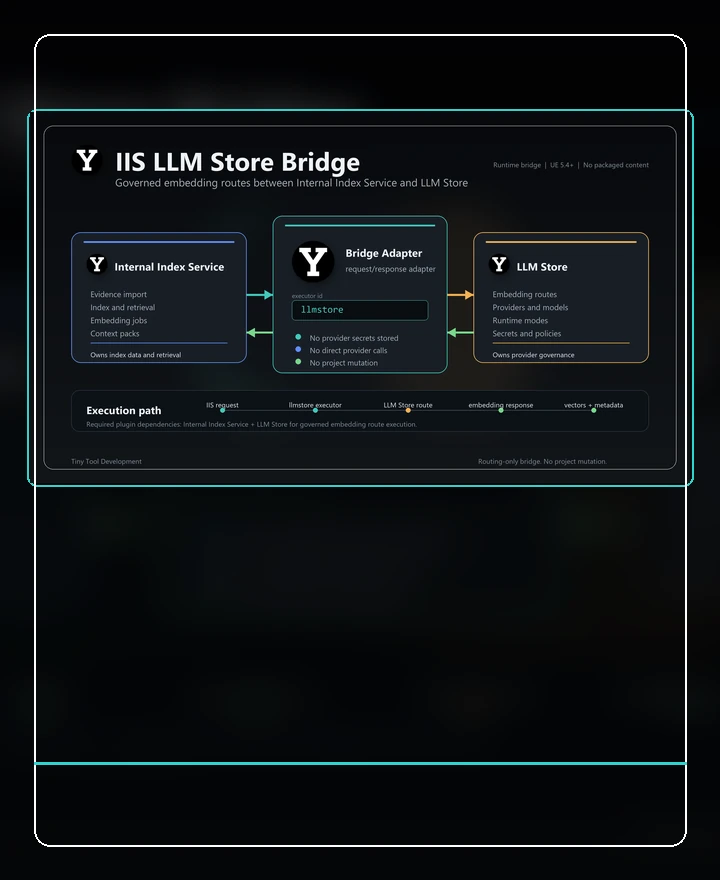
Connects IIS embedding jobs with LLM Store routes and governance.
More context
The bridge connects systems without blurring the ownership boundaries of the core plugins.
- Boundary
- Free companion bridge that registers IIS executor id llmstore and adapts IIS embedding requests to LLM Store routes without moving provider governance into IIS.
- Workflow
- Enable IIS, LLM Store, and the bridge, configure an LLM Store embedding route, verify executor id llmstore, then run IIS embedding jobs through bridge diagnostics or normal IIS workflows.
- Functions
- ResolveEmbeddingRouteViaBridge; ExecuteEmbeddingRouteViaBridge; ExecuteSimpleEmbeddingViaBridge
- Settings
- EmbeddingExecutorId; llmstore; RouteId
- Failure modes
- Bridge Not Registered; LLM Store Unavailable; Embedding Route Missing

Example Projects
Free companion
UII IIS Bridge
UII extracts rich evidence — then it sits in a folder IIS never indexes.
UE5.4StateMixed State - implemented free companion bridge outside active buyer-doc gate scopeSurface1 bridge
Connects UII handoff artifacts with IIS import, catalog, retrieval, and context-pack workflows.
More context
The bridge connects systems without blurring the ownership boundaries of Unreal Integration Intelligence and Internal Index Service.
- Boundary
- Free companion bridge that reads UII handoff contracts from disk and docks prepared evidence into IIS through IIS public APIs without moving import ownership into UII.
- Workflow
- Enable UII, IIS, and the bridge, generate the UII iis_import_contract.json handoff, then run the bridge pipeline for import, catalog, bounded embedding jobs, smoke search, and context packs.
- Optional bridges
- UCM
Editor Tools
In Publishment
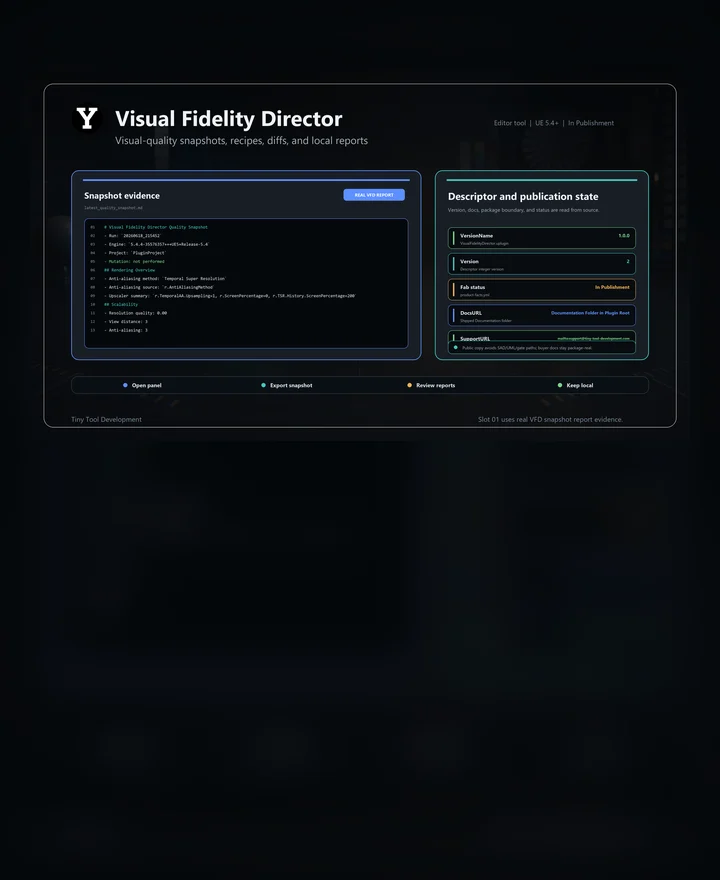
Visual Fidelity Director
UE5.4StateDescriptor, source, schemas, package filter, buyer docs, product facts, cockpit automation tests, Blueprint library, and showcase asset are reconciled for 2.0.0; fact-bound product-image rework remains a tracked follow-up outside this repo tree.Surface8 functions / 4 settings / 6 failure modes
Visual Fidelity Director 2.0.0 is in publishment with a profile-centric cockpit, fidelity profiles, evidence lanes, governed persistent apply, multi-frame live metrics, Blueprint library, and integrated Expert Tools for legacy snapshot/recipe workflows.
More context
Visual Fidelity Director is in publishment as an Unreal Editor plugin for profile-centric visual-quality review. The 2.0 cockpit exposes composition axes with variant selection, inheritance path, provenance, findings, profile comparison, and approval-gated config writes, while Expert Tools keeps 1.x snapshot, recipe, scanner, and session preview workflows.
- Boundary
- Profile-centric visual-quality cockpit and diagnosis layer above Unreal rendering settings, fidelity profiles, evidence, governed config apply, recipes, reports, and guarded preview apply.
- Workflow
- Open Tiny Tools > Visual Fidelity Director, refresh the Cockpit page, review profiles and composition axes with variant/provenance detail, compare profiles, optionally approve governed persistent apply, and use Expert Tools for snapshots, recipe dry-runs, and session preview apply with rollback.
- Functions
- Cockpit Refresh; Profile Comparison; Governed Persistent Apply
- Settings
- Axis Intent; Governed Apply Destinations; Preview Apply Support (Expert Tools)
- Failure modes
- Live Metrics Unavailable; Governed Apply Skipped Everything; Preview Apply Skipped Everything
Editor Tools
In Publishment
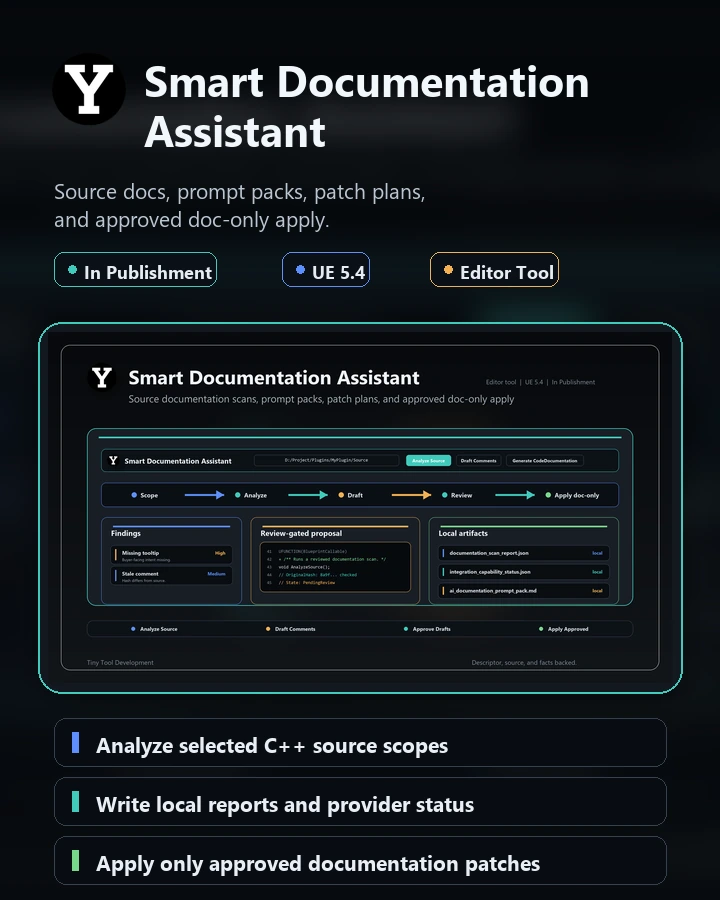
Smart Documentation Assistant
UE5.4StateUE 5.4 Win64 compilation and clean BuildPlugin succeeded; full SDA automation recorded 87 total with 86 succeeded, 1 expected succeeded-with-warning fallback disclosure, and 0 failures; five AES-encrypted UE 5.4-5.8 archives passed 5/5 vault-backed extraction checks; real compiled-panel captures 09/10 are recorded. The signed-in Fab portal was inspected read-only and remains an incomplete, unsubmitted draft. UE 5.5-5.8 archive rows prove staged source-upload metadata and extraction, not local compilation.Surface4 functions / 6 capabilities / 8 settings / 9 failure modes / 2 bridges
Audits C++ source documentation and drafts review-gated documentation patches.
More context
Smart Documentation Assistant 1.3.0 is in publishment as a standalone-first Unreal C++ source documentation assistant: deterministic analysis works alone; the editor can run approval-snapshotted, nonblocking AI draft jobs through an optional modular provider; commandlets retain the bounded synchronous compatibility route.
- Boundary
- Standalone-first source documentation assistant for deterministic reflected/plain/free-function scans, optional same-file semantic findings, provider disclosure, prompt packs, patch plans, and review-gated documentation-only apply.
- Workflow
- Select a source scope, analyze documentation health, start a nonblocking draft generation or use local prompt fallback, inspect visible job/provider diagnostics, review PendingReview proposals, and apply only approved hash-checked documentation changes.
- Functions
- Analyze source; Run standalone workflow; Apply approved proposals
- Capabilities
- free_function_analysis; semantic_stale_analysis; provider_documentation_quality
- Settings
- ScopeId; RootPaths; bIncludePrivate

Editor Tools
In Publishment
Best Practices Journal
UE5.4StateRuntime, editor, developer-tool, storage, validation, import/export, candidate-promotion, application-brief, outcome, evolution-graph, and Capability Mesh route surfaces are implemented and covered by plugin testsSurface4 functions / 5 settings / 4 failure modes / 1 bridge
Best Practices Journal 1.1.2 captures, reviews, organizes, and reuses evidence-backed engineering practices inside the editor.
More context
Best Practices Journal helps teams capture, review, organize, and reuse engineering practices directly inside the Unreal Editor - project-local records about proven practices, trade-offs, evidence, review state, and lessons learned. Imported provider material remains a candidate until explicit human promotion. It is decision support and does not change source files or assets.
- Boundary
- Standalone editor practice governance journal for evidence-backed engineering practices and intent-only implementation handoffs.
- Workflow
- Create or import a candidate, attach evidence, complete an explicit human review and promotion when accepted, create an application brief, then import implementation outcomes after downstream work.
- Functions
- Create practice record; Search practices; Create application brief
- Settings
- StorageBackend; StorageScope; StorageRootOverride
- Failure modes
- Practice Validation Failed; Brief Guardrail Rejected; Provider Missing

Scene Tools
Available on Fab
Procedural Generated Structures
UE5.4StateProceduralGeneratedStructures.uplugin VersionName 1.0.3 / Version 4Surface4 functions / 3 settings / 3 failure modes / 1 bridge
Capture, preview, and rebuild instanced-static-mesh structures from a data asset, sync or across frames.
More context
Procedural Generated Structures builds reusable instanced-static-mesh structures from a data asset: capture existing ISM instances into a data asset, preview target components, blocking issues, mutation intent, progress, and exact post-prune counts, then rebuild those exact instances or generate additional row-based structures synchronously or spread across frames so the editor and game stay responsive.
- Boundary
- Builds reusable instanced static mesh structures from data assets with exact replay, generated rows, and rebuild planning.
- Workflow
- Place an Async Procedural Generated Actor, capture named instanced mesh components into a Procedural Structure Data Asset, inspect the build plan, and rebuild or extend the structure with row rules.
- Functions
- AAsyncProceduralGeneratedActor; UProceduralStructureDataAsset; GetBuildPlan
- Settings
- InstancesPerFrame; bUseAsyncBuild; bCenterGeneratedTransforms
- Failure modes
- Build produces no instances; Captured instances moved/recentered unexpectedly; Build hitches the editor / game on large structures

Engine Plugins
In Publishment
Asset Loader Studio
UE5.4StateAssetLoaderStudio.uplugin VersionName 1.0.1 / Version 3Surface3 functions / 3 settings / 3 failure modes / 1 bridge
Asset loading, table snapshots, dependency graphs, validation, governed mutation, and audit workflows.
More context
Asset Loader Studio is in publishment as a standalone Unreal plugin for structured asset-data work: runtime load jobs, Blueprint access, editor workspace inspection, preview/apply governance, audit records, and optional UCM/UMCP reach paths.
- Boundary
- Standalone premium runtime/editor workspace for asset loading, table snapshots, dependency graphs, validation, governed mutation, and audit.
- Workflow
- Submit load requests, inspect job status and diagnostics, capture table snapshots, preview governed operations, apply allowed changes, and review audit records.
- Functions
- SubmitLoadRequest; CaptureTableSnapshot; PreviewOperation
- Settings
- DefaultProfileId; AllowedRoots; AuditRetentionDays
- Failure modes
- Missing Assets; Permission Denials; Failed Saves
AI Plugins
In Publishment
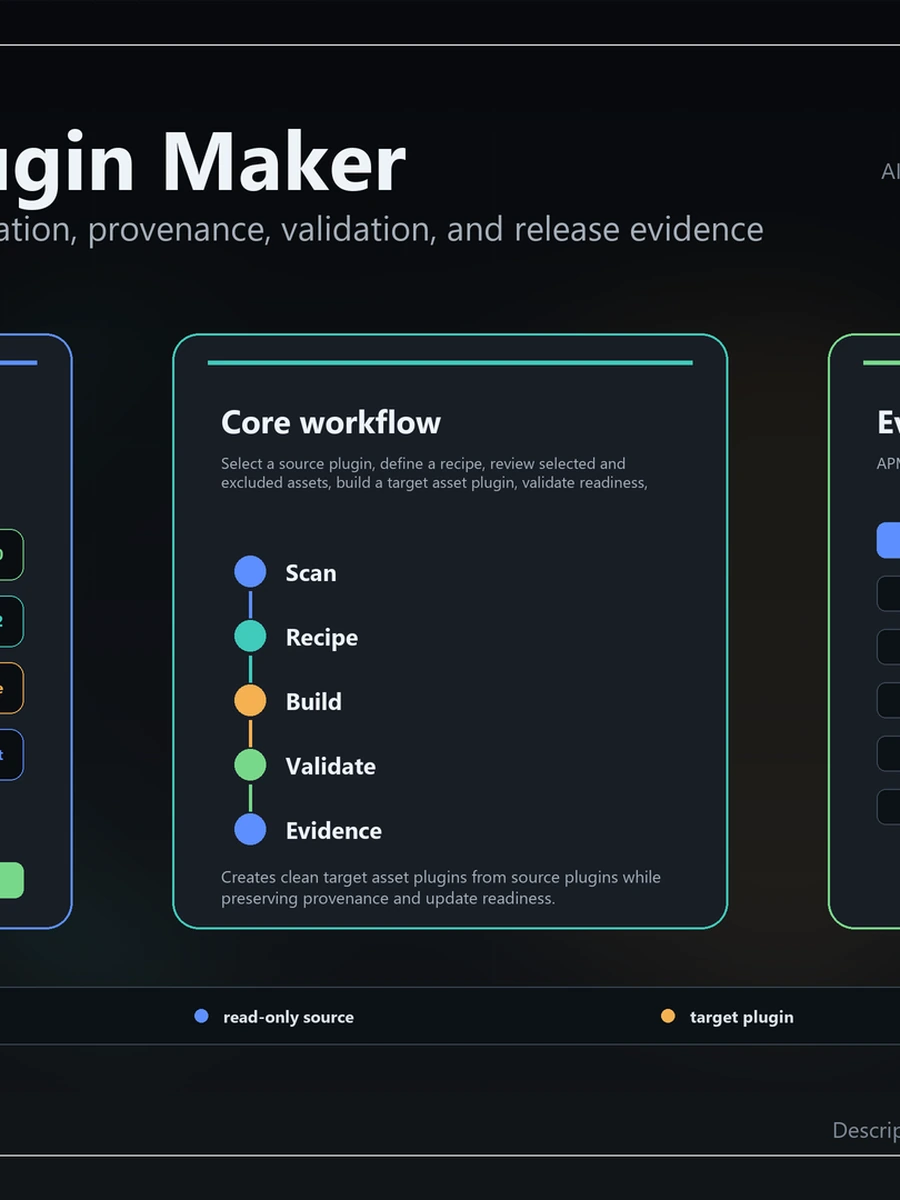
Asset Plugin Maker
UE5.4+ targetStateAsset-plugin and content-packaging mechanisms are implemented; both explicit and graph-derived ProjectContent edges are excluded from descriptor dependencies while build ordering is retained, imported classes accept only Class redirects, and all 14 compiler tests passed under UE 5.8; the 5.4-to-5.8 release ladder and exact target map/experience/PIE proof remain separateSurface14 functions / 7 settings / 9 failure modes / 5 bridges
Asset Plugin Maker combines Content Browser asset-to-plugin actions, UE 5.4-first profile-driven multi-pack content packaging, and recursive cross-project inventory. Scoped scans can expand None/Hard/HardAndSoft closure; pack modes duplicate/remap, preserve exact plugin or project package identity, or validate reviewed existing content. Exact Lyra gameplay equivalence remains unverified.
More context
APM scans selected source assets, adopted plugin mounts, scoped external content-packaging sources, or Unreal project plugin containers; pins source engine identity; records source-link snapshots and package facts; stores mappings and profiles as JSON; builds portable Asset Plugins or exact package layouts including sidecars and World Partition trees; records provenance and artifact/entrypoint indexes; exports rebuild contracts; and exposes plugin-local UCM manifests. Artifact materialization is distinct from target class/plugin compatibility, map load, experience activation, and PIE proof.
- Boundary
- Builds reviewable Asset Plugins and non-mutating cross-project inventories while preserving provenance and keeping transfer behind explicit approval.
- Workflow
- Right-click assets or folders for the buyer-facing Make/Add flow, or drive deterministic UE 5.4+ content-packaging profiles for scoped multi-pack work. For governed project composition, pin source engine/mounts/paths/closure, review each pack migration mode and target kind, audit the no-overlay plan and report index, and stop for explicit human review before mutation or behavioral claims.
- Functions
- Make Asset Plugin; Add To Asset Plugin; Adopt existing plugin
- Settings
- bShowEditorConfigurationsShortcut; SavedRoot; ReviewPackageRoot
- Failure modes
- Scoped source profile is rejected; ProjectContent or exact package execution is refused; A preserved map has missing World Partition content or does not behave like the source

Engine Plugins
In Publishment
Geo Provider Store
UE5.4+StateGeoProviderStore.uplugin VersionName 1.0.1 / Version 3Surface5 functions / 3 settings / 5 failure modes / 1 bridge
Provider gateway for geospatial APIs, local datasets, license policy, provenance, and reports.
More context
Geo Provider Store is an In Publishment Unreal plugin for safe provider discovery, mock/offline validation, local dataset import, restricted provider handling, and reportable geodata requests.
- Boundary
- Standalone provider store for geospatial APIs and local datasets with normalized responses, license policy, provenance, cache policy, and reports.
- Workflow
- List providers, configure credential/profile policy, execute a mock or approved provider request, inspect provenance/license results, and write a reviewed request report.
- Functions
- List Providers; Execute Request; Write Request Report
- Settings
- bEnableMockProvider; bAllowNetworkRequestsByDefault; CredentialProfiles
- Failure modes
- Provider Is Missing; Network Request Is Blocked; Google Request Reports Have No Payload

AI Plugins
Internal
Project Intelligence Orchestrator
UE5.4+StateVerified deterministic manifest, runner, journal, Port Blueprint, candidate write-back, enrichment/evaluation, and route mapping; content-packaging and composition compile/execute/materialize/verify implementations have UE 5.4 automation evidence while project acceptance remains an operator-owned activitySurface6 functions / 3 capabilities / 8 failure modes / 3 bridges
Project Intelligence Orchestrator 1.0.27 coordinates governed project-intelligence workflows and deterministic composition drafts, target-non-mutating preflight, approved execution, and findings-bearing verification through UCM routes and auditable journals. Blueprint translation runs carry UBI macro-aware graph and compiler evidence to UCI's native C++ port plan without taking Blueprint mutation authority; project acceptance remains explicitly human-gated.
More context
PIO validates workflow and composition manifests, invokes owner-held route seams, records run journals and artifacts, writes project-intelligence reports, and runs grounded enrichment/evaluation without owning transfer, mutation, journal promotion, or provider logic. The UE 5.4+ implementation enforces evidenced content-source mirror skips, a report-writing dry-run-only mode that performs no target transfer or wiring materialization, and variant comparison only for two passed reports with startup and frame measurements.
- Boundary
- UCM-first workflow orchestration layer that compiles reviewable drafts, requires evidenced mirror decisions, separates non-mutating preflight from real execution, and journals route-based runs without taking mutation or verification authority from route owners.
- Workflow
- Collect read/evidence, consume recursive source/target inventories, compile a deterministic draft, stop for explicit human review, run an approved target-non-mutating preflight, execute separately, and verify without promoting degraded or missing measurements to a pass.
- Functions
- ValidateWorkflowManifest; RunWorkflow; ExportHandoff
- Capabilities
- manifest_mode_validation; ucm_route_gateway_required; sensitive_input_redaction
- Failure modes
- CompositionMirrorSkipRejected; CompositionPreflightOnly; CompositionDraftRejected

AI Plugins
In Publishment
Unreal Blueprint Integrator
UE5.4 targetStateVerified inventory/deep export/translation-diagnostics/analysis/report/index/candidate/compare and route/audit surfaces; macro provenance and compiler evidence feed native C++ planning without a Blueprint graph-repair route; governed mutation preview/apply/rollback verified for configuration/DataAsset materialization typesSurface6 functions / 2 settings / 6 failure modes / 5 bridges
Unreal Blueprint Integrator makes Blueprint assets reviewable as deterministic local evidence and exposes governed configuration/DataAsset mutation. Executable behavior and type adaptation remain native C++ work; Blueprints are composition surfaces.
More context
UBI 1.2.4 exposes the evidence pipeline, scoped read-only Blueprint compiler diagnostics, and FUbiMutationAssetOps for validated configuration/DataAsset changes. Preview remains read-only; apply requires a matching token, mutation profile, backup or explicit created-asset state, transaction, compile where applicable, save, and audit; rollback restores backups or removes only the asset created by that operation.
- Boundary
- Autark Blueprint evidence and governed configuration/DataAsset mutation plugin. Version 1.2.4 scans and exports macro-aware Blueprint truth, reports scoped compiler diagnostics, and preview/apply/rolls back evidence-backed configuration changes without hard companion dependencies.
- Workflow
- Configure ScanRoots and ExcludeRoots, run Scan Blueprints or UbiScan (optionally with -DeepExport), review Saved/UBI/inventory/project.json and Saved/UBI/exports/project.deep.json, and capture compiler state through ubi.translation.diagnostics.v1; continue into analysis (Saved/UBI/analysis/ with claims[]), reports (Saved/UBI/reports/), candidates (Saved/UBI/journal-candidates/ with observedClaims), and indexes (Saved/UBI/indexes/) via UCM routes or the editor workspace; governed mutation preview/apply/rollback is available via ubi.mutation.* routes with backup, transaction, save, and audit.
- Functions
- ScanProject; UbiScan commandlet; Deep graph export
- Settings
- ScanRoots; ExcludeRoots
- Failure modes
- UbiScan prints ok false and exits 1; Inventory contains fewer Blueprints than expected; Deep export records contain anim_graph:anim_state_machine_traversal_pending or construction_script:scs_graph_traversal_pending incomplete entries

AI Plugins
In Publishment
Unreal Code Integrator
UE5.4StateVerified local planning/apply/rollback and port-plan tests, including direct mapping of compiler-failing Blueprints in UII translation evidence to native C++ candidates; release package and Fab portal evidence remain target evidence before live availability.Surface4 functions / 3 settings / 3 failure modes / 2 bridges
Controlled implementation planning, review, dry-run reporting, and approved Unreal project change coordination with native C++ candidates for compiler-failing Blueprint behavior.
More context
Unreal Code Integrator is in publishment as a standalone Unreal plugin for deterministic request intake, integration planning, translation-evidence-backed Blueprint-to-C++ port planning, safety gates, report writing, approved file/config changes, and rollback manifests without autonomous agent mutation. Failed Blueprint behavior and type adaptation are planned as native C++; Blueprint assets remain composition surfaces.
- Boundary
- Review-first integrator that imports approved implementation intent, builds deterministic plans, validates gates, writes reports, and applies approved low-risk project file changes with rollback evidence.
- Workflow
- Import or create a request, BuildPlan or prepare a review-only port plan, validate gates, review reports, ApplyPlan only after approval, and RollbackApplyJob when needed.
- Functions
- BuildPlan; ApplyPlan; RollbackApplyJob
- Settings
- DefaultPolicyProfileId; bDryRunDefault; MaxFilesPerApplyJob
- Failure modes
- Plan Approval Missing; Apply Approval Missing; Rollback Manifest Missing

Outer Tools
Not Applicable
ArchitecturalKnowledgeDB
Architecture knowledge exists, but it is scattered across docs, diagrams, Git history, and people's memory.
UENot an Unreal Engine pluginStateCurrent implementation - standalone Python architecture knowledge database and MCP/HTTP/CLI serviceSurface9 functions / 7 settings / 5 failure modes / 5 bridges
Local-first architecture knowledge service for DB-native SAD/UML authoring, ADRs, provenance, drift, recall, reasoning, and agent-ready context.
More context
ArchitecturalKnowledgeDB (AKDB) is a standalone Python outer tool in its own repository. It uses SQLite by default or PostgreSQL for opt-in concurrent writers, directly authors structured SAD documents and UML through CLI, FastAPI, and MCP, and exports deterministic root/subsystem projections. It also imports externally owned architecture, scans Git metadata read-only, and provides search, context, cognition, completeness, memory, reasoning, review, and guardrail services without taking ownership of another repository's data.
- Boundary
- Standalone architecture knowledge service that directly authors its own SAD/UML, indexes externally owned sources with provenance, and exports deterministic reviewable projections.
- Workflow
- Author AKDB-owned SAD sections, decisions, and UML directly in the database, validate and query them, then export the versioned docs/architecture projection; for externally owned projects, register/import read-only sources, scan provenance, query context, and reingest after the owner changes them.
- Functions
- Project setup and registry import; Import architecture corpus; Author and export SAD/UML
- Settings
- AKDB_DATABASE_PATH; AKDB_SOURCE_ROOT; AKDB_DEFAULT_PROJECT
- Failure modes
- MCP search returns no project context; Reingest cannot write to the database; Semantic recall is unavailable

Outer Tools
Not Applicable
AI-Assisted Graphical Modeling Workspace
UENot an Unreal Engine pluginStateFact-backed product entrySurface5 functions / 3 settings / 2 failure modes / 1 bridge
Folder-based graphical UML editor with patch-first AI co-authoring and optional AKDB context enrichment.
More context
AIaGMW (AI-Assisted Graphical Modeling Workspace) is a TypeScript monorepo under Tools/AIaGMW. It opens a folder workspace, edits semantic UML models graphically, validates changes, and routes AI proposals through a reviewable patch engine. Publication to the TTD architecture corpus happens via PlantUML export to Git/UML, not by writing directly to AKDB.
- Boundary
- Standalone local-first UML modeling workspace where semantic JSON is canonical, diagrams are views, and AI co-authors submit reviewable patches.
- Workflow
- Open or create a workspace, model class/component/package (and V2 diagram types), review AI patch proposals, export PlantUML to Git/UML, reingest AKDB for retrieval.
- Functions
- Open workspace folder; Graphical class diagram editing; Submit and review patch proposal
- Settings
- MODEL_WORKSPACE_ROOT; AIAGMW_CONNECTORS_ENABLED; AIAGMW_AKDB_URL
- Failure modes
- Connector unavailable; Import conflict

Outer Tools
Not Applicable
TrackShape Toolchain
UENot an Unreal Engine pluginStateSpec-backed embedded toolchain; inner repository state managed separately from the parent workspaceSurface4 functions / 4 settings / 3 failure modes / 2 bridges
Deterministic Python toolchain for raster tracing, shape validation, Unreal spline compilation, reports, and optional MCP apply.
More context
TrackShape is the processing half of the external Track Shape workflow. It consumes track_shape.v1 files or two-color raster images, emits editable shape JSON, trace reports, compile reports, and unreal_spline_points.v1 output, and can optionally apply results to Unreal through an explicit dry-run-first MCP path.
- Boundary
- Python compiler/tracer/apply toolchain that turns track_shape.v1 or raster inputs into reports and derived Unreal spline point JSON.
- Workflow
- Trace a two-color image into track_shape.v1 or compile an authored shape file, inspect the report, write compiled Unreal spline points, and optionally apply to Unreal only with explicit approval.
- Functions
- Compile track shape; Trace track image; Dry-run apply
- Settings
- --shape; --out; --report-out
- Failure modes
- Compile exits nonzero; Trace emits warnings or no path; Apply does nothing

Outer Tools
Not Applicable
Track Shape Editor
UENot an Unreal Engine pluginStateCurrent implementation - local TypeScript/React editor with Docker and optional Tauri wrapperSurface4 functions / 3 settings / 3 failure modes / 2 bridges
Local graphical editor for deterministic track-shape JSON used before compiling or applying Unreal spline points.
More context
Track Shape Editor is the UI half of the external track-shape workflow under Tools/TrackShapeEditor. It edits, validates, previews, imports, and exports track_shape.v1 files through a React/Vite editor, Docker helper, and optional Tauri wrapper while delegating compiler/tracer/apply work to the sibling TrackShape toolchain.
- Boundary
- Local visual authoring UI for track_shape.v1 JSON; compiler, raster tracing, and Unreal apply belong to the TrackShape toolchain.
- Workflow
- Open or create a track_shape.v1 file, edit anchors/handles/layouts, inspect validation and metrics, save JSON, then call the TrackShape toolchain for trace, compile, or dry-run/apply steps.
- Functions
- Edit track shape JSON; Validate and inspect metrics; Import image or call tracer
- Settings
- EDITOR_PORT; VITE_PORT; TRACK_SHAPE_DIR
- Failure modes
- Compile or trace action fails; Saved file does not compile; Buyer docs imply Node or Vite is required for ASB

Editor Tools
Internal
Editor Extension Base
Editor plugins keep reimplementing the same selection, checkout, and undo-adjacent wiring.
UE5.4.0StateDescriptor and source are inspected. The editor/runtime modules and focused host-test module compile and link on UE 5.4. Three dedicated tests cover empty input, empty save input, and unsavable transactional state, but runtime execution is pending because an unrelated duplicate AssetPluginMakerEditor class registration failed before test discovery in the concurrently used project.Surface4 functions / 3 failure modes
Supplies reusable editor widget bases, selection helpers, undo preparation, asset-action orchestration, and runtime macros.
More context
The editor module exposes generic UMG and editor utility foundations; the runtime module contains shared macros. The mutation path now filters eligible transactional assets before opening one scoped transaction, stops after failures, skips unsafe saves, and reports checkout/save outcomes explicitly.
- Boundary
- Internal shared editor foundation that is not a Fab buyer product and is not approved as a new hard dependency for mutating tools until its safety spec is green.
- Workflow
- Internal consuming plugins subclass generic widget or utility bases and explicitly own their product behavior; mutating consumers remain behind the transaction safety gate until focused runtime automation is green.
- Functions
- GetSelectedLevelActors; ExecuteUndoableAction; GetLastExecutionResult
- Failure modes
- Mutating action leaves partial or unsaved state; Public plugin cannot load after packaging; Runtime module fails on a case-sensitive host

Scene Tools
Design / emerging target architecture
Game Featured Classes
Featured gameplay classes can become hard to track when the runtime shell, package docs, and feature rules drift apart.
UE5.4.0StateCurrent package shell implemented; premium GameFeature Workbench target specified only.Surface13 functions / 9 settings / 6 failure modes / 4 bridges
Target architecture for a premium GameFeature Workbench with feature-class data assets, world-scoped actions, runtime registry resolution, discovery graph visualization, descriptor governance, guided repair, audit reports, sample fixtures, and optional Tiny Tools automation.
More context
GFC keeps Unreal GameFeatures and Experience systems as the activation/orchestration authority while adding a premium workbench around them. Feature authors declare classes and requirements; consumers resolve by feature id, role, interface, or fallback policy; maintainers scan a graph of descriptors, Experiences, actions, classes, consumers, blockers, and build decisions; validators inspect descriptors, action data, soft references, and build-target compatibility; repair services preview, stage, apply approved fixes, verify, audit, rollback/undo supported changes, and write local proof artifacts.
- Boundary
- GFC is a premium GameFeature Workbench that makes Unreal GameFeatures discoverable, authorable, validatable, visualizable, repairable, automatable, and safe to consume through declarative featured class contracts.
- Workflow
- Scan the feature graph, inspect descriptor/action/class findings, validate definitions and feature sets, author or repair featured class definitions through guided UI, register classes through standard GameFeature actions, resolve them through the runtime registry, and export graph/validation/repair proof.
- Functions
- RegisterFeaturedClasses; ResolveFeaturedClass; ActivateFeatureSet
- Settings
- bValidateDescriptorsOnStartup; bRequireExplicitlyLoaded; bWarnEnabledByDefault
- Failure modes
- Feature class lookup returns missing.; Feature activation is blocked.; Deactivated feature leaves behavior behind.
Engine Plugins
Advanced Preview
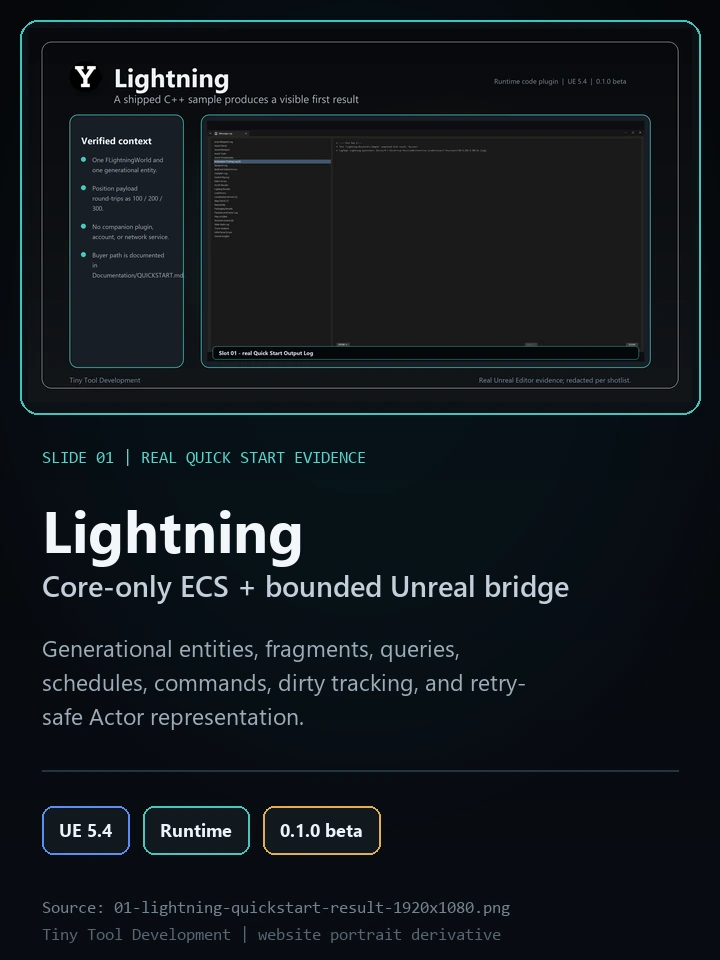
Lightning
Runtime data layout and Unreal object lifecycles become tightly coupled when one layer owns both.
UE5.4StateRuntime, unified buyer documentation, package-real Quick Start sample, generic dirty-apply failure diagnostics, three-run SpawnDestroy evidence, two real Unreal Editor captures, and the clean six-slide gallery are recorded; the final Fab upload archive and saved portal draft remain pending.Surface4 functions / 3 settings / 3 failure modes / 1 bridge
Dependency-light data-oriented ECS runtime primitives plus a separately bounded Unreal bridge and optional bridge-local representation pooling.
More context
Lightning packages LightningCore and LightningUnrealBridge as sibling runtime modules. LightningCore owns plain entity, fragment, chunk, query, system, scheduler, dirty-tracking, transition, command-buffer, arena, and statistics contracts while depending only on Core. LightningUnrealBridge owns owner-token resolution, input gather, dirty output apply, structured MissingOutputFragment and ForcedOutputApplyFailure diagnostics, Actor representation transitions, optional bridge-local pool providers, and the fixed SpawnDestroy benchmark.
- Boundary
- One Unreal runtime plugin combining a Core-only ECS module with a separate Unreal object and Actor bridge module.
- Workflow
- Install and enable Lightning in a C++ project, run the shipped LightningQuickstartActor for a visible Output Log result, use FLightningWorld for plain ECS work, and optionally bind Unreal owners through ULightningBridgeWorldSubsystem for retry-safe presentation and representation work.
- Functions
- Create and run a Lightning world; GatherInput and ApplyDirtyOutput; ApplyRepresentationTransition
- Settings
- ChunkCapacity; RepresentationPolicy; PoolKey
- Failure modes
- Stale entity or owner is rejected; Dirty output remains set; Pool transition fails or degrades

Scene Tools
Internal
Lightweight Dummy Actor System
Heavy actor lifecycles get awkward when teams need a lighter representation layer before promotion is safe.
UE5.4.0StateMVP 1+2+3 runtime, editor, developer, and automation tests implemented; optional adapters remain target.Surface4 functions / 4 settings / 3 failure modes / 4 bridges
Autonomous Unreal dummy actor representation system with snapshot transfer, promotion/demotion policy, diagnostics, editor inspector, validate commandlet, and optional project adapters.
More context
LDAS is designed as the Tiny Tools actor-representation bridge between scene runtime, future LightningCore entity representation, BPJ practices, and optional automation workflows. The core stays autark and WarCollection-neutral; WarCollection support is specified as an adapter/pilot that maps Experience, GameFeature, PawnData, PawnExtension, ASC, mesh readiness, authority, and replication contracts into LDAS readiness probes.
- Boundary
- LDAS is a project-agnostic runtime representation service that keeps logical subjects in lightweight dummy actors and promotes them to heavy actors only when policy and readiness contracts allow it.
- Workflow
- Register a logical subject, run it as a lightweight dummy actor, inspect readiness, and promote or demote it through explicit policy and snapshot transfer.
- Functions
- RegisterSubject; RequestPromotion; RequestDemotion
- Settings
- DefaultDummyActorClass; bAllowRuntimePromotion; PromotionCooldownSeconds
- Failure modes
- Promotion request remains dummy.; Demotion request keeps heavy actor active.; Dummy actor appears but has no rich visual.

AI Plugins
In Publishment
Project Design Assistant PDA
UE5.4+StateHermetic serializer, workspace discovery, journal import, single-file journal fallback, canonical Source assembly, reconciliation, reflection, degradation, Phase-7 UML, and handoff tests exist; Windows editor coverage and live UCM mesh smoke are recorded. PDA still owns preparation and never claims target-project execution authority.Surface5 functions / 2 settings / 4 failure modes / 1 bridge
Builds and compares versioned UML design workspaces, keeps journal evidence traceable, and hands reviewed reimplementation intent to an owning executor.
More context
Project Design Assistant 1.0.2 stores deterministic pda.workspace.v1 files, discovers manifest and canonical disk models, renders a two-sided UML canvas, imports typed and positioned journal features, reflects Destination models through local providers or an optional live UCM session, and records review outcomes. It may write only its own workspace and handoff artifacts; target asset/code mutation remains outside PDA.
- Boundary
- Editor Design Canvas for journal-backed Source design, artifact-derived Destination comparison, explicit deviation resolution, and guarded handoff without direct project implementation.
- Workflow
- Select or create a PDA workspace, open a model from the manifest-backed catalog, assemble a Source model from reviewed journal features or author it directly, reflect or load the Destination model, compare deviations, choose an explicit resolution, and export or dispatch a preparation-only handoff.
- Functions
- DraftDesignBrief; Workspace list/read/write; ReconcileDiff
- Settings
- ProjectsHomeDir; AuthorName
- Failure modes
- Workspace rejected; Compare rejected; Mesh reflection unavailable

AI Plugin Bridges
Bridge
SDA LLM Store Bridge
UE5.4StateSource inspection covers route, callback, parsing, retention, cancellation, and shutdown; host automation directly proves no-dispatch without approval and truthful best-effort cancellation.Surface2 functions / 2 settings / 4 failure modes / 1 bridge
Runs approved SDA documentation-drafting jobs through a governed native LLMStore route.
More context
The bridge registers sda.llmstore.native_async, requires explicit approval, submits the strict SDA schema to task route sda.source.comment.propose, marshals completion to the game thread, and leaves every accepted proposal pending human review.
- Boundary
- Optional companion that implements SDA's asynchronous provider contract through LLMStore without adding an LLMStore dependency to the standalone SDA plugin.
- Workflow
- Enable SDA, LLMStore, and this bridge, configure the SDA task route, approve one drafting job, poll its status, then review pending proposals in SDA.
- Functions
- ISDAAsyncAiDraftProvider modular feature; Provider id
- Settings
- TaskKind; Per-job external approval
- Failure modes
- Draft job degrades without dispatch; Draft job fails before dispatch; Strict response is rejected
AI Plugins
Bridge
Unified Epic MCP Bridge
UE5.8 Editor only; package exists on branch 5.8 and is intentionally absent from 5.4 through 5.7StateBranch 5.8 evidence: UE 5.8 Editor and Game gates passed with zero warnings on 2026-07-16, and 6/6 UnifiedEpicMcpBridge automation tests passed. This does not claim a package on branch 5.4.Surface1 function / 1 setting / 2 failure modes / 1 bridge
Branch-5.8-only Editor adapter from Epic MCP and Toolset Registry to Tiny Tool Execution.
More context
The branch 5.8 bridge consumes ITinyToolExecutionModule, preserves canonical and internal identities, shares one fail-closed allow-list across dynamic and fixed surfaces, maps typed results, forwards cancellation into TTER invocation state, and fully rebuilds on Epic tool refresh.
- Boundary
- On branch 5.8, projects allowed canonical TTER tools into Epic's Unreal Engine 5.8 Editor MCP surfaces without a second registry truth.
- Workflow
- On branch 5.8, discover live TTER tools, project admitted canonical IDs, register Epic surfaces, resolve calls to internal IDs, and rebuild on refresh.
- Functions
- Project allowed TTER tools into Epic MCP
- Settings
- EpicBridgeExposureMode
- Failure modes
- Epic call returns not_allowed; UnifiedEpicMcpBridge descriptor or module is absent
// LIVE AND NEXT
UMCP is on Fab; the advanced previews show what is already taking shape.
These cards separate marketplace availability from announced work in progress. The value text explains why each tool matters on its own and how it can join the wider Tiny Tool stack.
01
Available on Fab
Live marketplace release
Unified MCP Server
UMCP is now a Fab-listed product and anchors the local MCP gateway story for provider tools, UCM-backed job visibility, and editor-owned endpoint lifecycle.
One loopback host for local agents while provider plugins keep their own domain logic.
Open context
02
Available on Fab
Live marketplace release
Internal Index Service
IIS is a Fab-listed local project memory layer with retrieval, embedding, catalog, context-pack, and evidence workflows for agent-facing search.
Turns project material into local, auditable context for search and agent workflows.
Open context
03
In Publishment
Publication queue
Smart Content Diet
SCD is in publishment with analyzer coverage, governance snapshots, cleanup queues, and preview/apply-safe boundaries ready for buyer-facing review.
Makes asset growth, cleanup candidates, review boundaries, and lead-facing reports visible before release pressure appears.
Open context
04
In Publishment
Publication queue
Smart Documentation Assistant
SDA is in publishment with source documentation scans, provider-status disclosure, prompt packs, patch plans, and review-gated documentation-only apply.
Turns source documentation drift into local reports, pending proposals, and hash-checked review work.
Open context
05
In Publishment
Publication queue
Asset Plugin Maker
APM is in publishment with source snapshots, recipes, target-plugin builds, origin ledgers, BOMs, validation reports, and release candidate evidence.
Turns selected Unreal content into reviewable target asset plugins with provenance and publication boundaries.
Open context
06
In Publishment
Publication queue
Asset Loader Studio
ALS is in publishment with load jobs, table snapshots, dependency graphs, governed operations, audit records, and optional UCM/UMCP routes.
Makes structured asset-data work inspectable before load, edit, apply, and support conversations.
Open context
07
In Publishment
Publication queue
Geo Provider Store
GPS is in publishment with provider registry, mock/offline validation, GIS import, request reporting, license policy, and provenance handoffs.
Keeps geodata requests useful for authoring without losing provider and license context.
Open context
08
In Publishment
Publication queue
Unreal Blueprint Integrator
UBI 1.2.4 is in publishment with Blueprint inventory, deep graph export, scoped compiler diagnostics, deterministic analysis, reports, evidence indexes, permission gates, audit, and mutation safety from UE 5.4 onward.
Turns Blueprint assets into reviewable local evidence before porting, refactor, or automation work.
Open context
09
In Publishment
Publication queue
Unreal Code Integrator
UCI is in publishment with deterministic request intake, integration planning, Blueprint-to-C++ port plans, safety gates, dry-run reports, approved apply, and rollback manifests.
Keeps implementation planning reviewable before source or config changes cross the mutation boundary.
Open context
10
In Publishment
Publication queue
Best Practices Journal
BPJ 1.1.2 is in publishment with evidence-backed candidates, explicit human promotion, practice records, application briefs, import/export reports, outcomes, and optional provider integrations from UE 5.4 onward.
Turns hard-won team lessons into reusable, reviewable editor knowledge without taking mutation authority.
Open context
11
Advanced Preview
Announced ecosystem executor
Project Restructure Service
PRS is the guarded execution layer for reviewed restructure plans: validate, dry-run, gate, apply, hash-check, and roll back.
Lets IIS, UII, SCD, or human planning stay separate from the actual mutation boundary.
Open context
12
In Publishment
Publication queue
Unreal Integration Intelligence
UII 1.1.3 is in publishment with scoped profile validation, project evidence export, System Dossiers, optional Translation Evidence, review packs, RAG chunks, and handoff contracts from UE 5.4 onward.
Feeds IIS retrieval, PRS execution planning, SCD migration findings, and local agent context without taking over downstream ownership.
Open context// STRUCTURE
From first scan to support without detours.
-
01
Start with the pain, not the feature list
Each tool page opens with the problem slide and a walkthrough of the real editor surface — so you know what you are buying into.
-
02
Open GitHub when you need the manual
Quickstarts, settings references, troubleshooting, and release notes live in GitHub. This site is the readable on-ramp.
-
03
Checkout on Fab, support starts on Discord
Listed products link to Fab for license and purchase. Product questions and support discussion route to Discord first, with formal plugin support at support@tiny-tool-development.com and general contact through the contact form.
-
04
No tracking theatre
Static site, no first-party cookies, no auto-loaded embeds. Tutorial widgets load only when you explicitly ask.
// DOCUMENTATION
GitHub carries the deep documentation; this site makes it easier to enter.
Use this page for visual orientation, then open GitHub for manuals, quickstarts, settings references, and technical notes.
Showcase Repository
Central product overview, categories, and entry points for all documentation.
OpenAI Plugins
LLM Store and Internal Index Service with governance, provider, and retrieval documentation.
OpenFoundation Plugins
Unreal Capability Mesh and setup-driven interoperability foundations.
OpenEditor Tools
Performance, logging, naming, copyright, and broader editor productivity.
OpenScene Tools
Spline, track, road, wall, and side-object workflows.
OpenExample Projects
Free companion integrations and reference adapters between separate products.
OpenOuter Tools
Standalone modeling and architecture tools around the Unreal plugin ecosystem.
Open// CHANNELS
One visual overview here, specialized detail where it belongs.
This website is the readable layer. Fab handles marketplace context, GitHub carries the full documentation, Discord is the first support route, and LinkedIn provides professional background.
Fab Marketplace
The commercial product pages live on Fab. Use this site first for a clearer overview, then open Fab for price, license, and checkout details.
OpenGitHub Documentation
GitHub holds the documentation hub, category pages, product manuals, quickstarts, and technical references.
OpenLinkedIn is the public company context for Tiny Tool Development, background, and project credibility.
Open// CONTACT
Product question, support, or Fab listing preparation?
Use the form for structured requests. It prepares an email draft and does not submit the message to a website database.
// OUTBOUND :: MAIL
